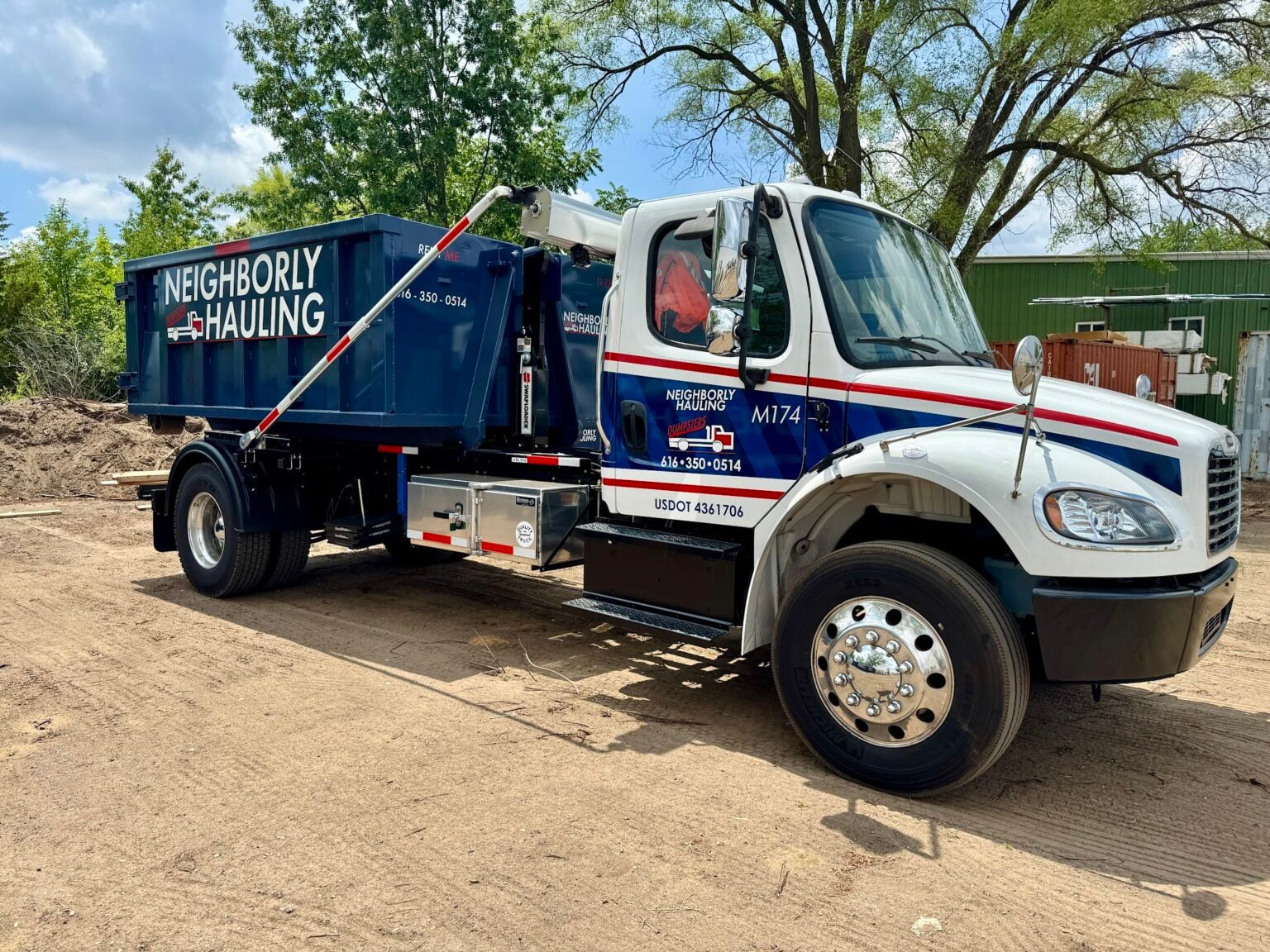
A hook-lift dumpster truck lifts containers directly rather than dragging them with a cable. This gives the driver precise placement control, allows delivery into tighter spaces, and eliminates the driveway scraping and cable-snap risks of traditional roll-off systems.
Equipment Guide · Grand Rapids & West MichiganWhen you rent a dumpster, the truck delivering it matters as much as the bin. Not all haulers use the same equipment — and the difference between a traditional cable roll-off and a hook-lift system shows up in where your bin can land, how safely it gets there, and how well your property is protected after.
Hook-Lift vs. Cable Roll-Off — Side by Side
| Cable Roll-Off | Hook-Lift ✓ NH | |
|---|---|---|
| Placement method | Dragged off the truck bed via winch cable | Lifted and lowered with hydraulic arm ✓ |
| Space required | Long straight run needed to drag bin clear | Works in short, angled, and curved driveways ✓ |
| Control during delivery | Cable tension — bin can shift unexpectedly | 3+ contact points maintained throughout ✓ |
| Failure mode | Cable snap = uncontrolled bin | Hook stays connected — no free-floating bin ✓ |
| Driveway impact | Steel rails scrape and slide on surface | Lifted, not dragged — no scraping ✓ |
| Rolliskate placement | Difficult while bin is sliding | Bin hovered above surface for safe pad placement ✓ |
| Tight access | Limited — needs clear long approach | Works around cars, fences, trees, garages ✓ |
Four Reasons Hook-Lift Is Better for West Michigan
Precise placement in tight neighborhoods and small driveways

Grand Rapids isn’t built for large roll-off trucks. Narrow alleys, curved driveways, garages close to the street, and dense neighborhoods like East Grand Rapids and Heritage Hill leave little margin.
A hook-lift gives the driver precise control of the bin throughout the entire placement.
- Bins placed in tighter spots than cable systems allow
- Maneuver around parked cars, garages, fences, and landscaping
- Deliver at sharper angles than traditional roll-offs
- Get dumpsters where others simply can’t
Three points of contact — bin is never free-floating

Traditional cable roll-offs use a winch to drag bins on and off the truck. Cables can snap. Bins can slide. When the cable fails, the dumpster is no longer under control.
Hook-lifts work differently — and more safely:
- Truck maintains three or more contact points throughout
- The bin is never free-floating or sliding uncontrolled
- No cables to break, tangle, or jerk the bin unexpectedly
- Hook stays connected even if something unexpected happens
Works in short, angled, and access-challenged driveways

Cable roll-off trucks need a long, straight clearance zone to pull the bin off the bed. There’s no adjusting mid-movement. Hook-lifts don’t have that constraint.
Because the driver can inch forward or backward while raising or lowering the bin, significantly less approach space is needed.
- Works in short driveways that dead-end at a garage
- Works in angled driveways without a straight run
- Works around trees, overhead wires, and tight access points
- If you’ve got a tricky property — this is the system for it
Dramatically less impact on your driveway and property
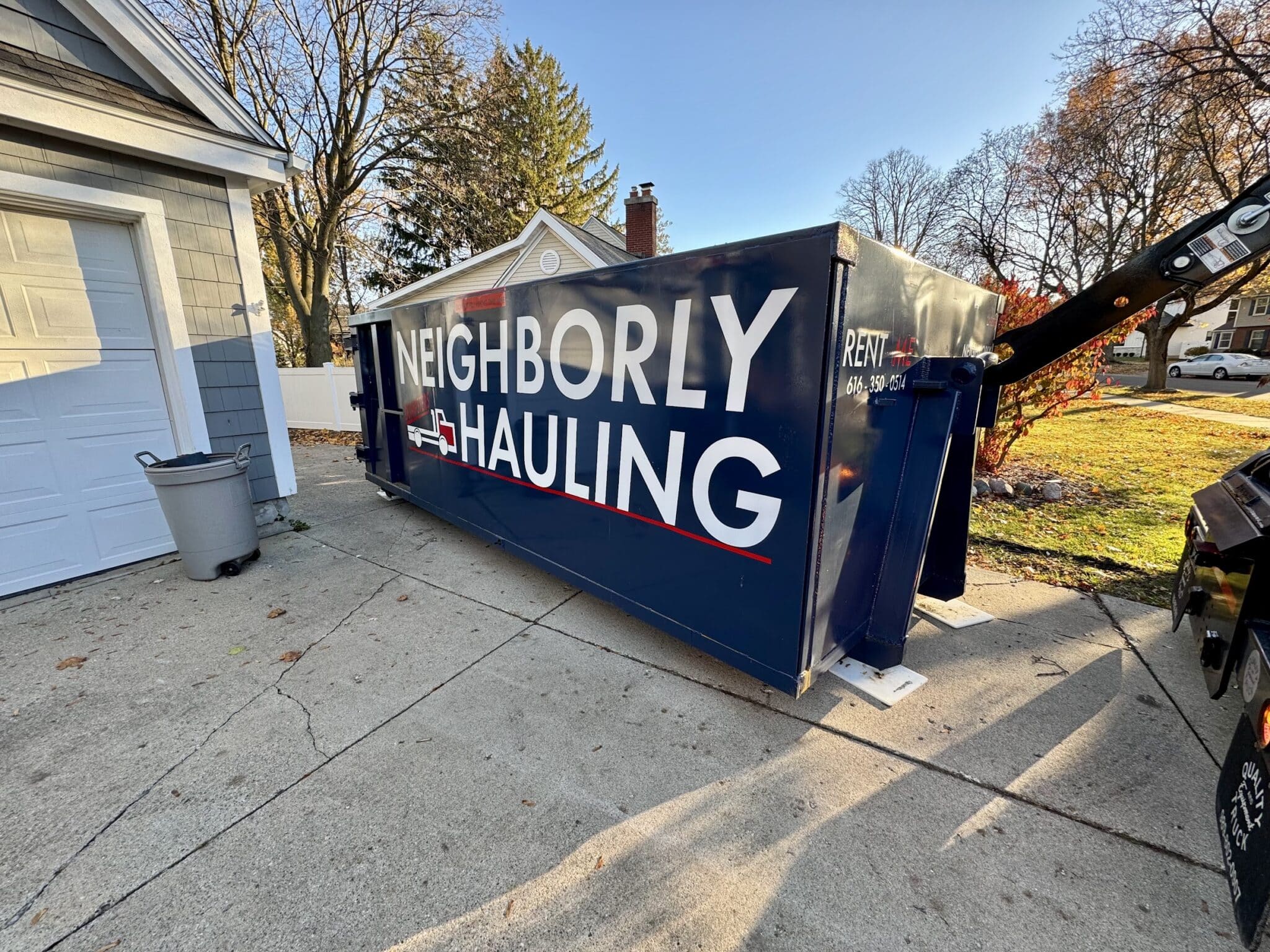
Traditional roll-offs rely on sliding the dumpster. Hook-lifts rely on lifting it. That difference determines whether your driveway comes out clean or scratched.
- Bin hovered above the surface — Rolliskate™ boards placed safely before the bin touches down
- No dragging heavy steel rails over concrete or asphalt
- Every inch of movement is controlled — no uncontrolled drops
- Clean repositioning without grinding into the surface
The result: no gouges, no scrape marks, no apology calls. Your driveway looks the same after the bin leaves as it did before it arrived.
Common Questions
What is a hook-lift dumpster truck?
A hook-lift truck uses a hydraulic arm that hooks onto a frame on the container and lifts it on or off the truck bed. Unlike a cable roll-off system that drags the bin, a hook-lift lifts it directly — giving the driver precise control throughout delivery and pickup, with the bin never free-floating or sliding uncontrolled.
Why is a hook-lift better than a cable roll-off for residential driveways?
A hook-lift requires significantly less approach space — it can work in short, angled, and curved driveways where a cable system can’t. It also lifts rather than drags the bin, so there’s no steel-on-concrete scraping, no cable snap risk, and precise enough control to hover the bin for safe driveway protection board placement before the container touches the surface.
Can a hook-lift dumpster truck reach my driveway?
Almost certainly yes — that’s the point of the system. Neighborly Hauling’s hook-lift truck is sized to fit standard single-car driveways and designed to maneuver around parked cars, fences, garages, and trees in the tight neighborhoods common across Grand Rapids, East Grand Rapids, and surrounding West Michigan communities.
Will the dumpster delivery damage my driveway?
No. The hook-lift system lifts rather than drags the bin, so there’s no steel scraping or sliding. Additionally, Neighborly Hauling places HDPE Rolliskate™ driveway protection boards under every bin before it touches the surface. Both the delivery method and the driveway boards are standard on every drop — no extra charge.
How is a hook-lift safer than a cable roll-off system?
A cable roll-off relies on tension in a single cable to control the bin during loading and unloading. If the cable snaps or slips, the bin loses control. A hook-lift maintains three or more contact points throughout the entire delivery process — the bin is connected to the arm at all times and never free-floating. There are no cables to break, tangle, or cause an unexpected jerk.
The Neighborly Difference
Hook-Lift Precision
Exact placement in tight spaces — curved driveways, short approaches, garages, fences. We get bins where others can’t.
Rolliskate™ Protection Included
HDPE driveway boards placed safely using the hook-lift hover — every drop, no charge, no request needed.
Square Dumpsters
Non-tapered walls maximise every cubic yard. 12, 17, 21, and 25 yard bins — all true capacity, no dead corners.
SMS Updates & On-Time Delivery
Text confirmation the day before, live update when en route. Your crew always knows exactly when the bin arrives.
A dumpster truck isn’t just a machine — it determines where your bin can go, how safely it gets there, and what happens to your property in the process. With a hook-lift system, Neighborly Hauling delivers placement accuracy, maximum safety, and dramatically less impact on your driveway — on every delivery across Grand Rapids and West Michigan.